Integrating Internal Family Systems (IFS) and Art Therapy.

Updated: Sep 15
By: Avery Chao| IFS Level 2 Therapist・ATR-BC・LCAT・Sensorimotor Trained・AEDP / EFT Trained
"I know I'm anxious, but I don't know why."
"Every time this topic comes up, my mind just goes blank."
"I can't put it into words — I just feel this tightness in my chest."
"I understand it logically. But I just can't do it — I stay stuck."
These are things I hear often in session.
As I wrote in a previous article, Internal Family Systems (IFS) holds that each of us carries many different "parts" inside. Some parts work hard to take care of others; some chase perfection; some fear rejection; and some carry the weight of old, wounded memories. Healing means these parts are understood and accompanied — not eliminated.
One of IFS's core beliefs is activating internal interaction through curiosity, compassion, and awareness, we slowly get to know our inner world, and how our different parts interact as a system.
The Gap Between Cognitive Understaning and Felt-Sense
But you may heard or personally experienced that "It all makes sense. I understand the logic. But I just can't stop feeling scared." That gap — between what a person understands and what they still feel — is often exactly where art therapy does its best work.
Some parts are quite talkative. They can explain themselves fluently and at length. But even for a part like that, drawing or sculpting it tends to surface things language never got around to saying. And for the parts that genuinely can't find words, art therapy offers an entry point that exists outside language altogether.
An Example
One situation is especially common: a relationship where a partner says "I love you" and is genuinely caring most of the time but in moments of emotional dysregulation, throws things, then withdraws by giving the silent treatment or ignoring their partner afterward. Cognitively, the relationship seems good — after all, he's always saying sweet, loving things. But what the body registers is a completely different signal: danger. This split between cognitive understanding and bodily experience often makes it nearly impossible for the client to describe what is actually happening inside her.
When Art Therapy Meets IFS
Mapping through Arts: Drawing a Map of the Inner System
Mapping in art therapy can help a client lay out the different parts of her inner world in a visual way. It also reveals some information such as the distance between these parts, and how close or far each one sits from Self, can help us see the shape of the whole internal system.
In this example, there may be a part that "rationalizes" — reading the emotional outburst as "inevitable," not really abnormal, finding excuses for the partner.
There may also be a part that habitually looks for the problem in herself — sometimes even thinking: he's such a good person normally, it's only with me that he acts this way, so it must be my fault. Maybe I wasn't clear enough. Maybe I'm not considerate enough. Maybe I'm not smart or emotionally attuned enough.
There may be a part that chooses to "surrender" — convincing herself the relationship is good enough, that she can't expect perfection.
But at the deepest layer, there's a part experiencing constant vigilance. No amount of explaining or rationalizing can truly settle that fear of being startled, the shock of things being thrown, or the insecurity of the person who is both intimate and threatening.

The rationalizing, self-blaming, and surrendering parts are all trying to quiet this vigilant part down, just enough to keep life running. Drawing out the relative positions of these parts — who stands closest to the vigilant part, who stands furthest away, who stands in the middle trying to mediate — that map itself often says a great deal that language hasn't caught up to yet. The process also helps the connection between cognitive level and bodily experience.
Externalize and Unblending: Making the Abstract Concrete, Creating Distance through Art Therapy
Externalize through art theapy help turning abstract inner experience into something concrete. For example, when the "rationalizing" part is drawn out, the image might hold tension, or an anxious urge to fill the picture, leaving little blank space. The artwork capturing nonverbal cues that words alone often do not express.
Once a part is placed on paper, it becomes something that can be observed, understood, and accompanied. In IFS, this is what's called Unblending — we begin to recognize, "I have an anxious part," rather than "I am anxious." As the artwork takes shape, a distance naturally opens up between the individual and that part.
The act of creating also connects to Self's own creativity — this curious, engaged, or calm creative process is itself an expression of Self leading.
Some inner Parts exist beyond language.
We often assume that if we can put something into words, we can understand it. But in IFS work, we discover that some parts aren't primarily experienced through language at all. They may show up as a bodily sensation, an image, an emotion, or an urge to move closer or pull away.
Take the client in the example above. She may not be able to name exactly what she's afraid of, yet the moment her partner approaches with silence, his facial expression changes, or even when there is no conflict at all and he is simply lost in thought, her body instinctively tenses and pulls away. She knows she's reacting, but she doesn't yet know which and what that part is experiencing, or why it has become so vigilant. What is showing up is a protective part that has learned to remain on high alert.
For these nonverbal parts, colors, shapes, spatial relationships, textures, and the creative process itself can become another pathway for understanding ourselves. Art does not speak on behalf of Parts; rather, it creates a space where Parts can be encountered.
Because some Parts are not simply "unable to speak." They may not want to speak, may not feel ready to speak, may not feel safe enough to speak, may not need language to communicate, or may even experience greater vulnerability when their experiences are put into words.

Sometimes, a Part is more easily understood through:
a color
a sense of distance
a tangle of chaotic lines
a symbol that keeps recurring
a pause, a hesitation, or the urge to tear up what's been made during the art making process.
Connecting your Inner Child; the Exile in IFS
As we continue exploring this example, we may begin to notice that the constantly vigilant part carries a feeling that is strangely familiar, yet difficult to put into words. This sense of familiarity often points toward a deeper core wound—one connected to our "inner child," or what IFS refers to as an Exile: a vulnerable part of ourselves that has been pushed away or hidden from awareness.
In this case, her exile part may be carrying memories of being abandoned, overlooked, or emotionally unseen. It may hold unresolved experiences of rejection, not being chosen, having one's needs ignored, or even being shamed for expressing those needs. In the context of Complex PTSD (CPTSD), trauma is often not the result of a single event, but rather the accumulation of repeated experiences over time.
These experiences can remain stored not only as memories, but also as bodily sensations, emotional responses, and protective patterns that continue to shape how we relate to ourselves and others.
Preverbal Parts in IFS
It is also possible that this vigilant part was formed much earlier in life. Many traumatic experiences, attachment experiences, and even implicit body memories occur before we have fully developed language to describe them.
For example, some preverbal parts may carry experiences from early childhood when a person had little autonomy over their own bodily needs. Imagine a young child who was not given the opportunity to recognize their own hunger and fullness cues, but was consistently fed by a caregiver. Even when the child was already full, turned their head away, or spit out the food, the caregiver continued to insist and feed them—often with good intentions and out of concern that the child was not eating enough. Yet, from the child's perspective, their own signals and boundaries were not being recognized and crossed, and they learned to override their internal experience in order to accommodate the caregiver.
Later in life, this person may struggle to distinguish between something that feels controlling and something that is offered with care, because in their earliest experiences, these two experiences became intertwined. If the client in our earlier example carries a similar early imprint, the nervous system may have learned to associate both affection and emotional dysregulation as part of the same relational pattern: "This is what love feels like." The body’s earliest experiences of love may have included both connection and the experience of having one’s needs overlooked or overridden.
Non-verbal Parts in IFS
Some Parts are indeed formed before the development of language. However, this is not true for all Parts. Many Parts may develop later in life, or they may have always been present but remain outside of conscious awareness and cognitive understanding, making them difficult to access through language alone.
This is often where people become stuck in the experience of, "I understand it intellectually, but I still can't change it." The insight is there, yet something deeper continues to respond in the same familiar way.
The value of art therapy is not only in supporting pre-verbal Parts. It also provides a gentler, non-threatening way for inner experiences that cannot yet be fully held by language to emerge, be processed, and be witnessed.
Reconnect: Art Therapy Is Not About Analysis, but About Reconnecting with Your Inner System
The purpose of art therapy is not to analyze Parts, but to create an opportunity for the internal system to reconnect, encounter, and build a relationship with itself.
Returning to the example above, we create space for the Parts that were once ignored, suppressed, or hidden away because hiding felt safer. It is like a child in a classroom who was rarely noticed being invited to stand in front of the class. Suddenly, there is space for them to be seen. Others approach with curiosity and care; some may even offer an apology or recognize their experience with empathy. This is the healing power of witnessing.
After the artwork is completed, we do not rush to interpret what the image "means." Instead, we pause and ask:
What does this Part want me to know?
What does this Part need most?
If I could stay present with this Part, how might its experience change?
What did this Part need back then but did not receive? Is there something I can offer to that younger version of myself now?
These questions often bring us closer to healing than asking, "What does this artwork represent?"
Many people assume that the purpose of art therapy is to create an artwork and then have the therapist analyze what the artwork means. However, in my approach, the artwork itself is not the only answer. What happens during the creative process—the emotions that emerge, the moments of hesitation, the choices made, the sensations noticed, and the relationship formed with the image—often reveals much more about the inner world.
The process of creating may come closer than the finished artwork to what a Part is truly trying to communicate and what it longs to heal.
From Understanding to Transformation and Self-led
The value of art therapy does not end with "understanding" and "being seen." It moves further toward transformation and integration.
The creative process engages multiple systems at once—including visual processing, touch, movement, imagination, and emotional experience—allowing different areas of the brain and the body to work together. Through sensory engagement and creative expression, art-making can support neuroplasticity, helping us develop new pathways rather than repeatedly returning to familiar patterns of protection and survival.
In art therapy, sensorimotor experiences help reconnect movements and bodily responses that may have become disconnected through trauma. The goal is not only to identify inner resources, but to practice accessing and embodying those inner resources.
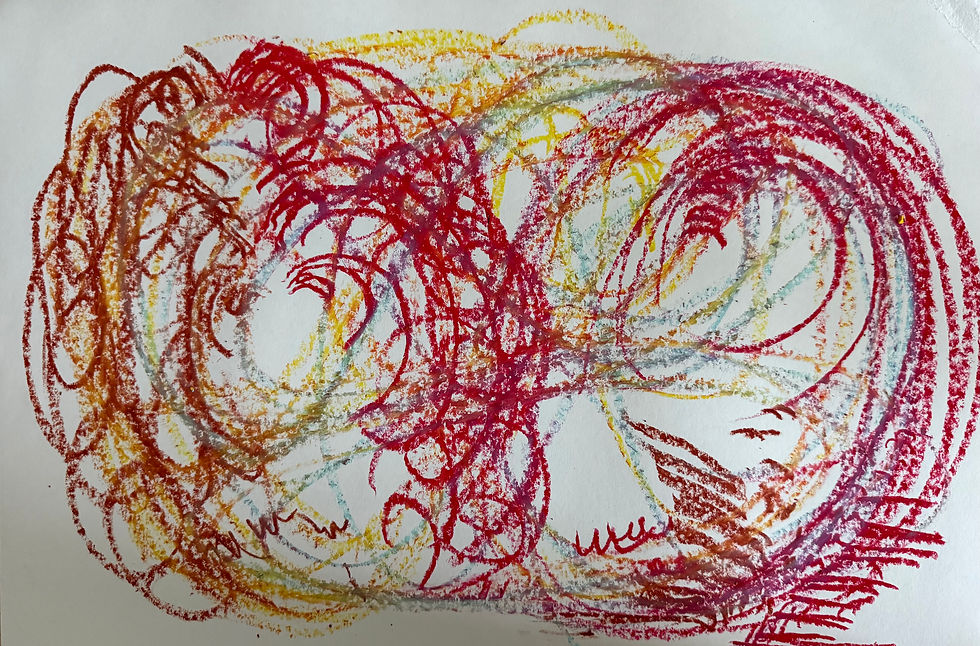
Returning to the example of the vigilant Part, the artwork may express its experience through qualities such as intense red colors, scattered marks moving in multiple directions, thick lines, or forceful pressure applied during creation. In contrast, a continuous and flowing movement—such as repeatedly tracing an infinity symbol (∞) in a bilateral rhythm—can represent a different kind of bodily experience: a rhythmic process of moving back and forth, regulating, and returning toward balance.
Through sensorimotor art therapy, we begin to create a bridge between the experience of the vigilant Part and the experience of safety. Rather than only talking about safety, the body has an opportunity to practice what safety feels like through movement, rhythm, and sensory experience.
From the perspective of Polyvagal Theory, when a person is experiencing trauma responses, the autonomic nervous system may become organized around states of threat—such as heightened mobilization (sympathetic activation) or shutdown and disconnection (dorsal vagal states). The body may remain prepared to fight, flee, freeze, or disconnect.
Art therapy that integrates sensory experiences and body-based movement can support the nervous system in gradually developing greater flexibility and returning toward states associated with safety, connection, and engagement (ventral vagal states). This process does not happen by using will power to override your body to relax or using cognitive understanding to override a protective response. Instead, through repeated experiences of safety, choice, rhythm, and embodied awareness, the nervous system can gradually rebuild its capacity for self-regulation.
In Summary: How Art Therapy Supports IFS Work
Mapping: Drawing out the relative positions and distances between inner parts helps a client see the shape of the whole internal system, not just the isolated feeling of a single part.
Externalize Your Parts: Giving inner parts a concrete form makes them visible, rather than leaving them to circle endlessly inside the mind.
Witnessing Through Art: The artwork itself becomes a form of witnessing, allowing long-ignored parts to finally be gently seen.
Support Unblending: The artwork creates an appropriate distance from the part, making it easier to understand from the place of Self rather than being flooded by them.
Deepen Self-Leadership: The creative process cultivates curiosity, patience, and compassion — supporting Self's capacity to lead the whole internal system.
Access Preverbal or Non-verbal Experiences: Reaching experiences and emotions that formed before language, giving parts that couldn't speak a way to be expressed.
Stimulate Neuroplasticity: Creative, sensory experience supports the brain in building new neural connections, promoting healing and flexibility.
Reconnect Mind and Body: Engaging the senses, movement, and body awareness helps reconnect parts that have been suppressed, dissociated, or cut off.
About the Author
Avery Chao is an IFS Level 2 therapist who also serves as a graduate art therapy supervisor and a clinical supervisor at a private practice in New York. She holds dual certifications as a Sensorimotor Art Therapy Guided Drawing practitioner and a Certified TF-CBT (Trauma-Focused Cognitive Behavioral Therapy) clinician, and has completed training in AEDP and EFT (basic and advanced levels), building a deep foundation in trauma treatment. She integrates IFS, art therapy, and body-oriented trauma work to help clients access inner experience that talk therapy alone can't always reach.
Working with clients, working with therapists and more about me.

Comments